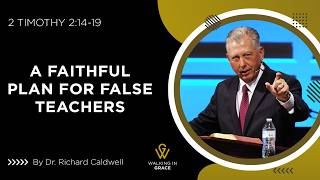
Dead Churches | Revelation 3:1-6
- Preacher
- Richard Caldwell
- Tradition
- Christian (Unspecified)
- Published
- Length
- 1:01:51
Scripture
About this sermon
Introduction: The church, by its very nature, and by God’s design, stands in supernatural contrast to its world. That is true in every age. That is true in every place. That is true in every part of the world. Even the most moral and orderly society of lost humanity is tragically different than the church of Jesus Christ. This is one of the reasons why God’s people can be appropriately grieved by the moral degradation of the world around us, but at the same time, never imagine that this present age will ever represent a kingdom of righteousness. The difference between the unbelieving world and the Lord’s church is the difference between LIFE AND DEATH. Lost humanity is spiritually dead. The church is spiritually alive. Lost humanity’s morality — at its very best — is still death. Lost humanity’s moral deeds — at their very best — are still filthy rags. Which is why it is shocking to hear the Lord of the church, as He assesses one of His churches, refer to that church as DEAD (vs.1). The church at Sardis was a dead church existing in a dying city. Sardis was located 30 miles southeast of Thyatira. It was once a living and vibrant city. It once was the capital city of Asia for Persia. But its glory was in its past. Alan Johnson — “Sardis retained its wealth into the first two centuries of the Christian era. But its political brilliance as the capital city of Asia for Persia lay in the past. Ramsay (Seven Churches, 375) aptly remarks, “No city of Asia at that time showed such a melancholy contrast between past splendor and present decay as Sardis.” In AD 26, Sardis begged the Roman Senate to grant it the coveted honor of building a temple to Caesar. The distinction, however, went to Smyrna. The luxurious living of the Sardians led to moral decadence. Herodotus (fifth century BC) wrote despairingly of Sardis and its people as “the tender-footed Lydians, who can only play on the cithara, strike the guitar, and sell by retail” (cited in Barclay, Seven Churches, 71). Sardis was a city of peace—not the peace won through battle but “the peace of the man whose dreams are dead and whose mind is asleep, the peace of lethargy and evasion” (Barclay, Seven Churches, 72).” Strangely and sadly, what was true in the community was true in this church. It was in a largely dead condition. What does that mean? And what is the remedy? I. THE LORD’S SELF-DESCRIPTION (vs.1) Once again, Christ introduces Himself to this church in a way taken from the first chapter. In each case He is highlighting what He has made known about Himself that addresses the particular problems or needs of a church. CHRIST IS THE ANSWER FOR THE CORRECTION OF HIS CHURCH. CHRIST IS THE ANSWER FOR THE DIRECTION OF HIS CHURCH. CHRIST IS THE ANSWER FOR THE PERSEVERANCE OF HIS CHURCH. CHRIST IS THE ANSWER FOR THE PROTECTION OF HIS CHURCH. A. THE HOLY SPIRIT Christ begins by describing Himself as the one who has the seven Spirits of God. We already talked about the fact that this is a symbolic way to speak of God’s Spirit. Christ is the one who demonstrated the fulness of the Spirit’s work in a human life. ESV Isaiah 11:1 There shall come forth a shoot from the stump of Jesse, and a branch from his roots shall bear fruit. 2 And the Spirit of the LORD shall rest upon him, the Spirit of wisdom and understanding, the Spirit of counsel and might, the Spirit of knowledge and the fear of the LORD. The Spirit of God is represented in Zechariah chapter 4 as a seven lamped lampstand. ESV Zechariah 4:1 And the angel who talked with me came again and woke me, like a man who is awakened out of his sleep. 2 And he said to me, "What do you see?" I said, "I see, and behold, a lampstand all of gold, with a bowl on the top of it, and seven lamps on it, with seven lips on each of the lamps that are on the top of it. 3 And there are two olive trees by it, one on the right of the bowl and the other on its left." 4 And I said to the angel who talked with me, "What are these, my lord?" 5 Then the angel who talked with me answered and said to me, "Do you not know what these are?" I said, "No, my lord." 6 Then he said to me, "This is the word of the LORD to Zerubbabel: Not by might, nor by power, but by my Spirit, says the LORD of hosts.
Preaching Revelation 3:1–6? Build your own sermon on this passage with SermonAI.
Try SermonAI free for 7 days